From digital communications to embroidery, Jovana Vlahović has channelled her love of home, family rituals and meaningful objects into an original brand in which every piece is created slowly, thoughtfully and with the idea that it should last.
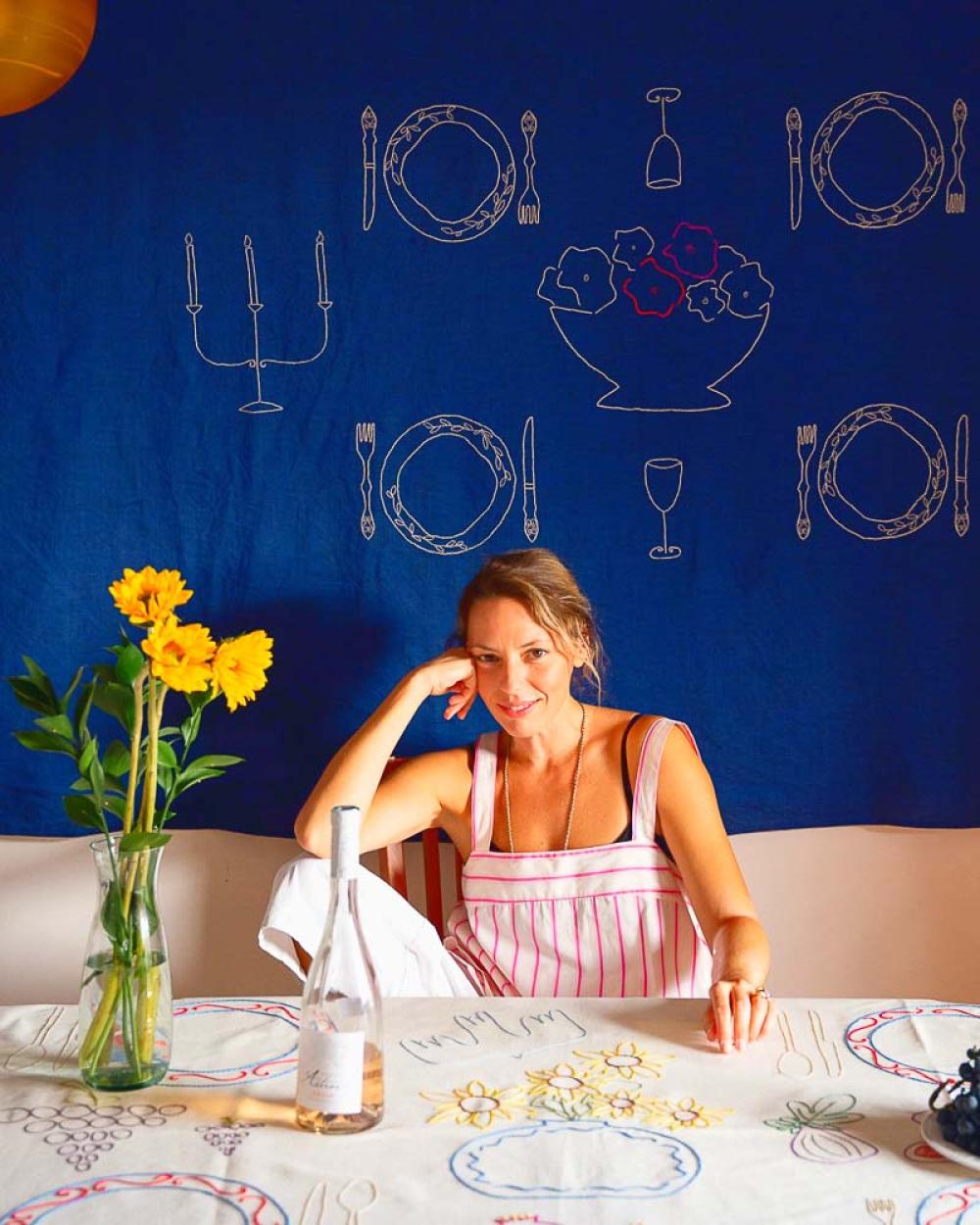
Jovana’s path to the Niti brand was not mapped out in advance. It grew out of a need to create with her hands, from family memories, a love of home and objects that, over time, become part of our lives. Today, through embroidery, she is building an original creative world of her own, slowly and without any desire to rush it.
There are objects we buy, use and forget, but there are also those that almost imperceptibly weave themselves into our everyday lives, becoming part of our homes, family gatherings and memories. These are precisely the kinds of objects Jovana wants to create through Niti.
Jovana Čelebić trained as a journalist, while her professional path took her through media, PR and communications in the festival and telecommunications industries, social media management and digital communications, which she later also worked on at UNICEF Montenegro. Yet one constant followed her through all these changes – the need to seek out whatever felt meaningful and worthwhile to her at that particular moment.
Today, for the first time, she feels that she is building something entirely her own from beginning to end, with her hands, from the initial idea to the finished object. Still, she does not see Niti as a final destination, nor as something that has to remain in the same form forever. “It is much more important to me to remain curious than to reach a point where I say: ‘That’s it, I’ve found my thing.’ I think I am on a good path now, but I like the fact that I still don’t know how far that path might take me,” our interviewee says.


And the path to Niti leads back to a table. Browsing Pinterest one day, Jovana stopped at images of romantic embroidered tablecloths and saw in them far more than fabric and embroidery. They took her back to childhood, to the family table where people lingered for hours, eating, talking, raising glasses, laughing and discussing things both important and completely trivial. She says she could almost hear the hum of conversation and dishes being passed across the table. Her mother, a museum advisor with an exceptional eye for beauty, carefully created the atmosphere of their home, while her father also had a deep appreciation for art. Jovana and her sister therefore grew up surrounded by paintings, exhibitions, sculptures, interior design magazines and the constant rearranging of their home, so their sense of colour, texture, detail and space developed almost naturally.
Her story, therefore, does not involve the traditional passing down of embroidery “from generation to generation”, but rather a special relationship with the home, objects and spaces that form part of everyday life. “I think that is where my great love of objects and spaces that take part in everyday life comes from, and it matters to me that they are beautiful,” Jovana tells Caffe Montenegro. That sensibility had existed for a long time, but through Niti it finally found a tangible form.
At the time she began thinking about embroidery, Jovana was still working in digital communications. The idea, however, increasingly occupied her thoughts, and she began thinking about embroidery almost obsessively, gradually teaching herself and practising. It took her almost two years to work up the courage to make something that would actually end up in someone else’s hands. Among her first pieces were two baby bodysuits for her niece Đina’s first birthday, and she still remembers her brother’s simple words: “You’re going to be good at this.”

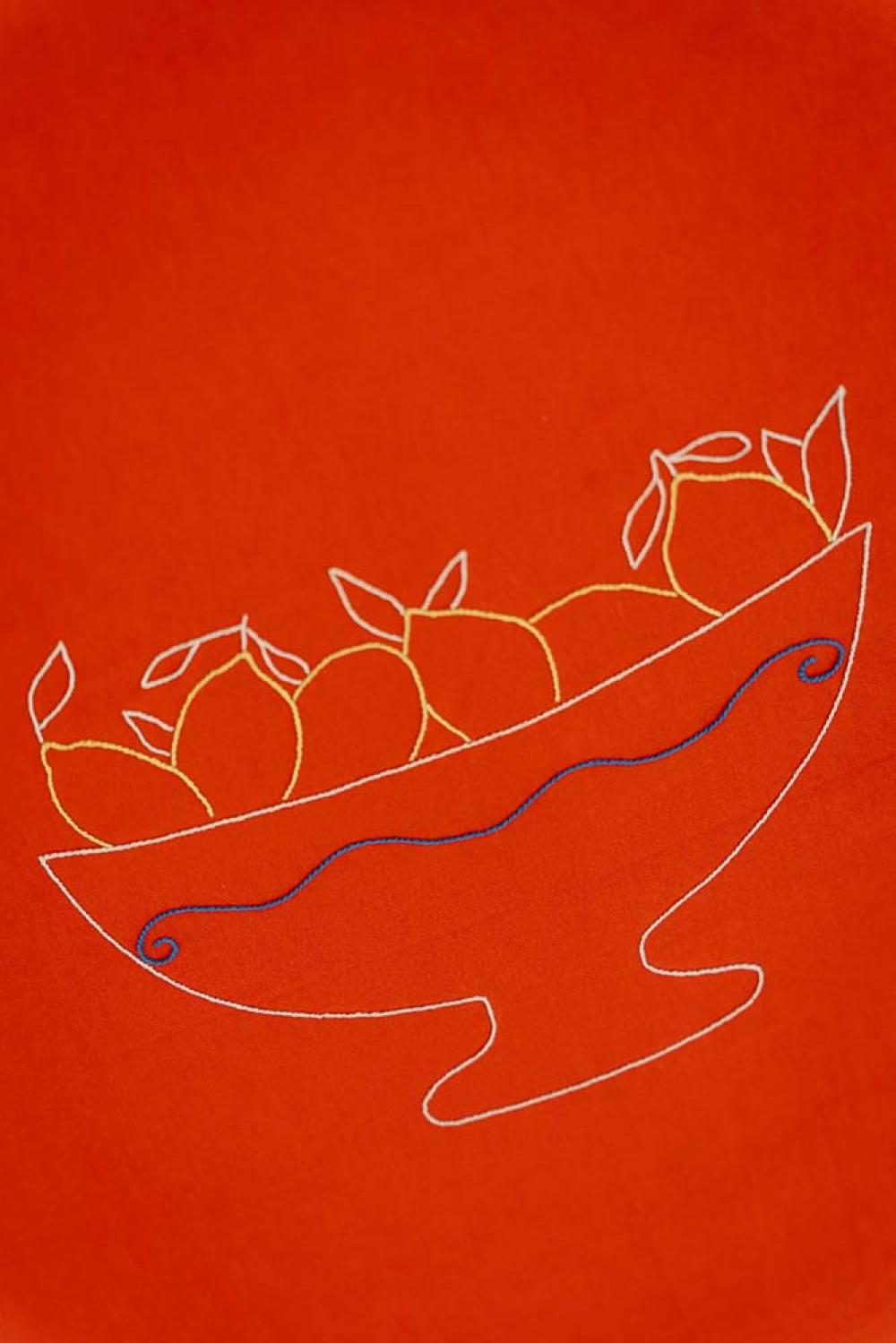
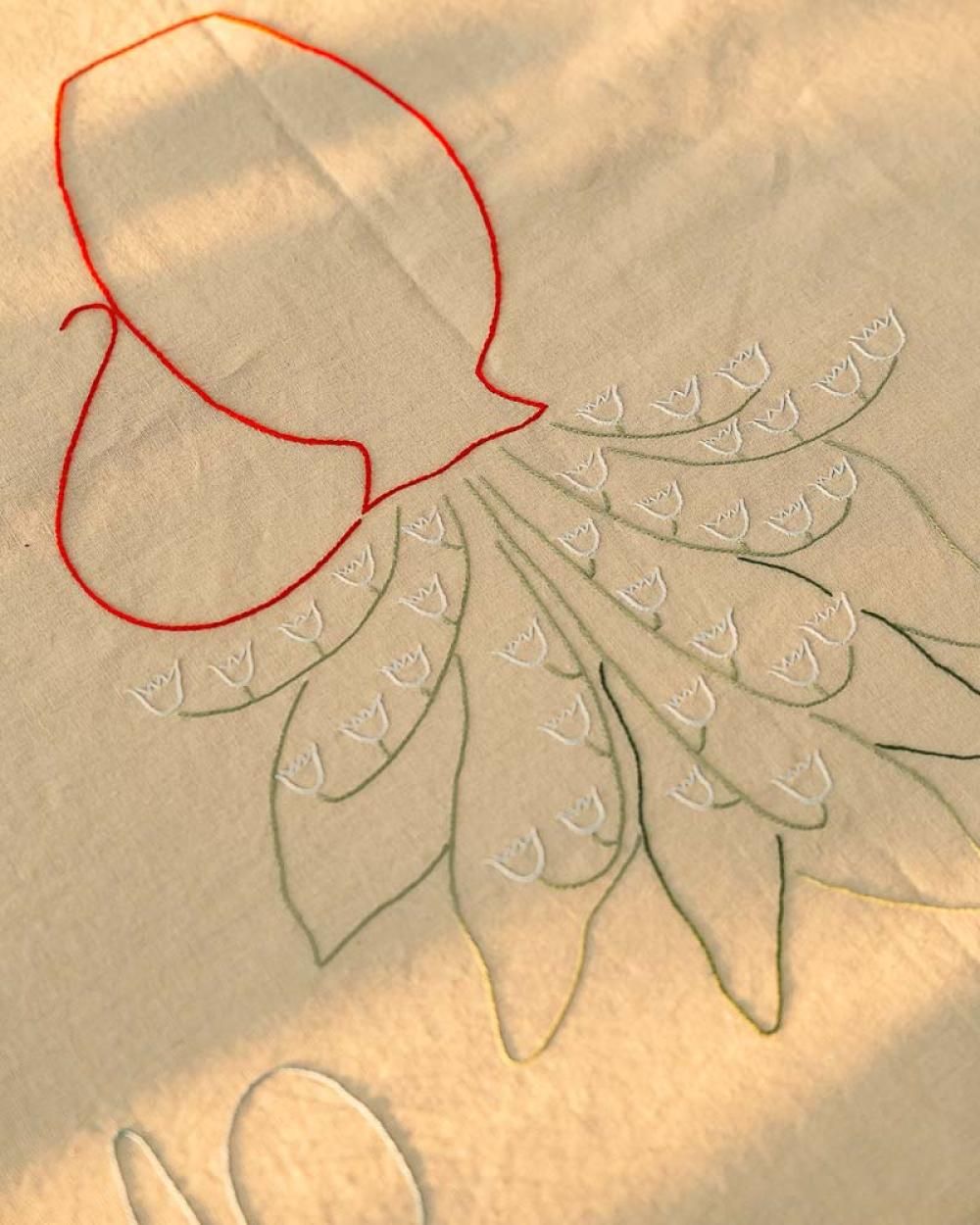
One of her earliest pieces that remains particularly dear to her was a T-shirt intended for the mother of two girls in the family. She asked them what their mother loved and what she represented to them, and they drew symbols that reminded them of her. Jovana transferred those drawings onto fabric and embroidered them, along with the message: “This T-shirt brings good luck.” Later, the woman for whom the shirt had been made told her that she had worn it during several important moments and that, in a way, it had become her lucky charm. Experiences like these showed Jovana just how much meaning a handmade object can acquire, far beyond its practical value.
Still, although people initially responded particularly well to the T-shirts, Jovana felt that embroidery was leading her towards home textiles. She made her first tablecloth almost a year later, for her own home. It featured motifs of home – the sun, birds and sky – and the response to that piece showed her clearly, for the first time, that there was a place for what she wanted to create beyond her private circle.
When she decided to create a profile and present her work to a wider audience, one question remained: the name. One evening, she was talking to her husband and he simply said: “Niti.” There was no need to think any further. The name immediately reminded her of a thought by Bishop Nikolaj Velimirović: “Whatever you weave, tie the threads to heaven,” which had long been important to her as a personal reminder to seek meaning in whatever she does. The name also fitted naturally with the change she was going through – from digital to analogue, from working within a system to building something herself, from the familiar to the uncertain. Even the logo was not created according to a plan. Her uncle, a lawyer by profession who has drawn and painted throughout his life, spontaneously created it in just a few minutes during an exchange of messages about the brand. And so, from the very beginning, without any deliberate plan, traces of the people closest to her became woven into Niti.
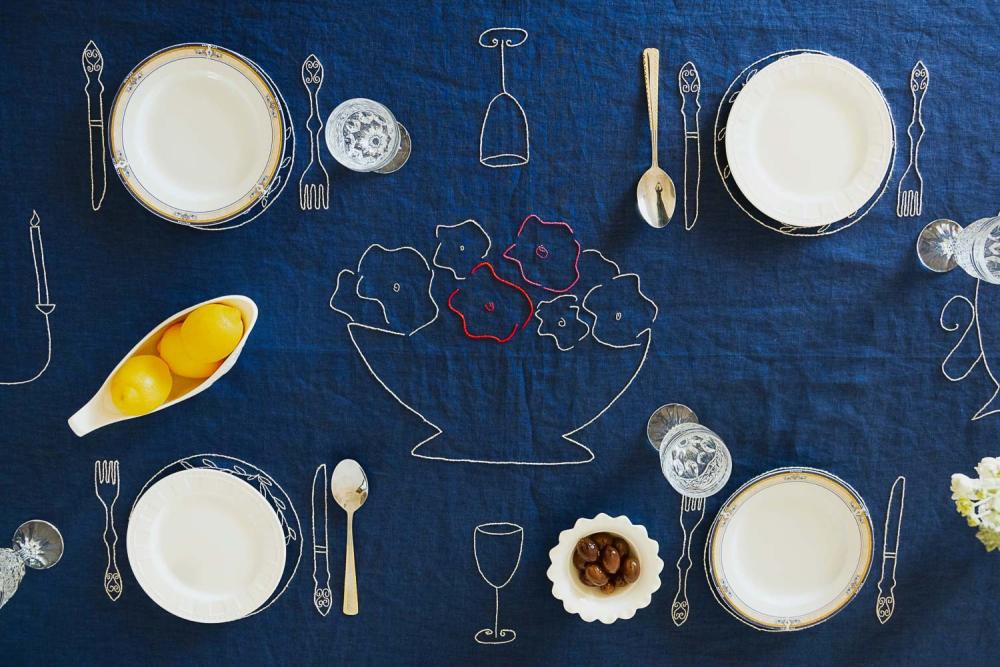
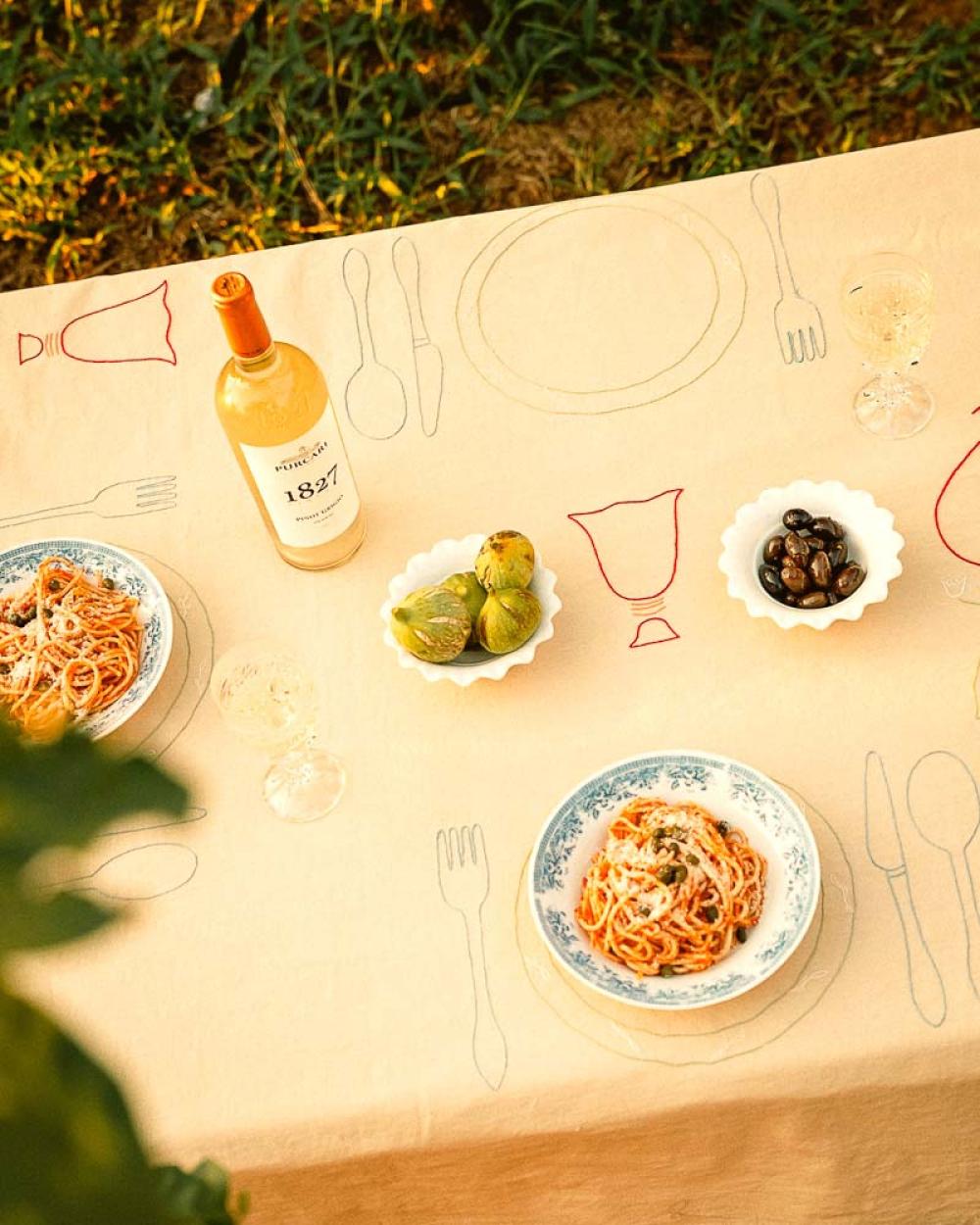
In photographs, handcraft often looks quiet, almost simple, but behind that image lie hours of drawing, experimenting, reworking and decision-making. The journey of one of Jovana’s products is almost never linear. Sometimes it begins with a clear idea, and sometimes with a fabric, colour or motif that catches her attention. When she was making a tablecloth for her own home, she wanted it to feature the sky, sun, birds, sunflowers, pomegranates, olives, figs and wine – not as a literal illustration of the surroundings, but as her translation of life around the house into textile.
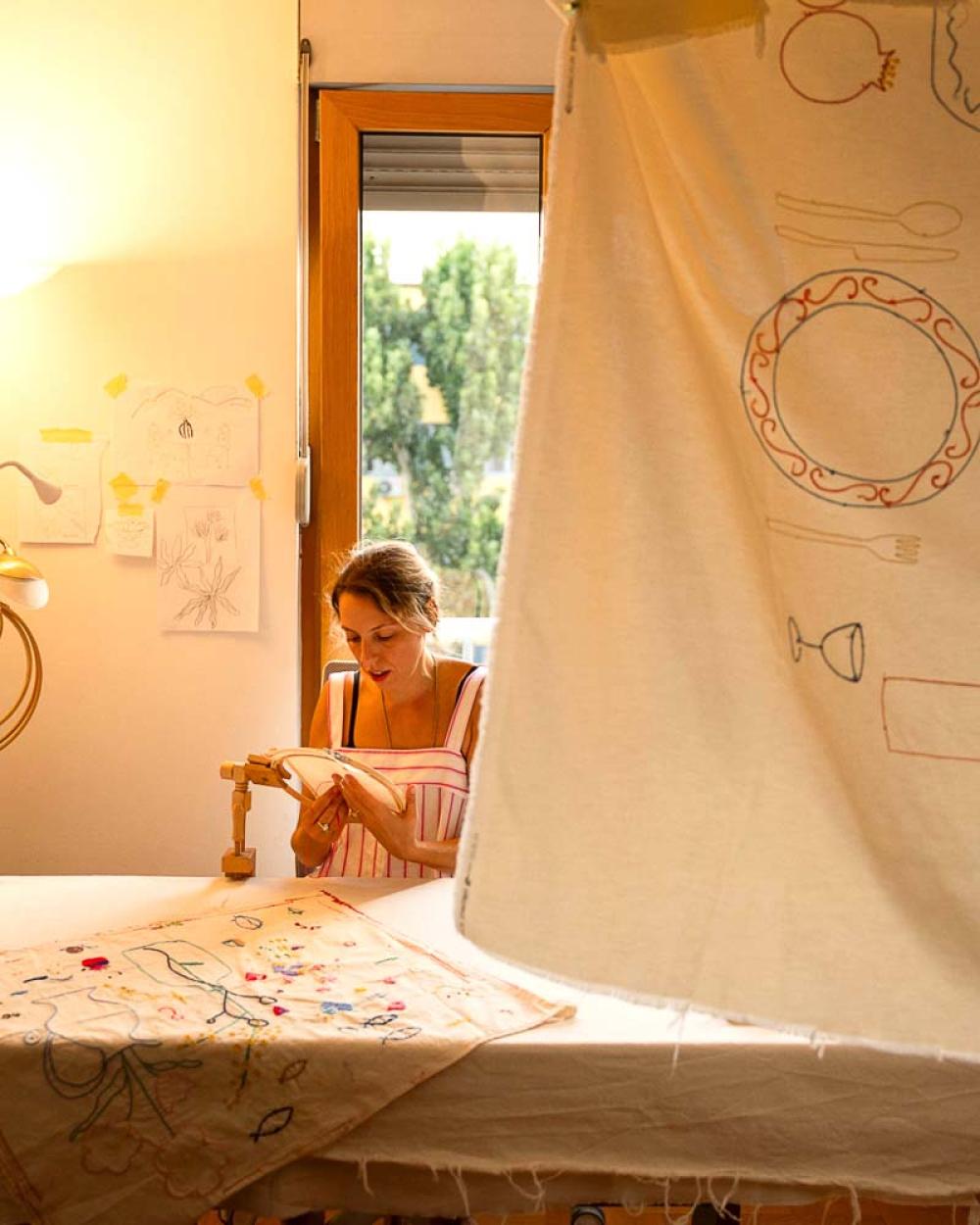
After the idea comes the drawing. She may draw a single motif dozens of times before arriving at a form she is happy with. The fabric then has to be prepared, the motifs transferred one by one and the colours coordinated, and even once the embroidery finally begins, the plan continues to evolve. One tablecloth for her home required around 60 hours of embroidery alone, and that is only part of the process, preceded by searching for motifs, drawing, choosing fabric and thread, testing colours and deciding which embroidery technique will make a particular detail look its best. She has also worked on a tablecloth approximately six and a half metres long, designed for a hospitality venue, where the challenge was not only the number of hours involved, but the entire composition, the relationship between motifs and the way the piece would function once laid out.
“What photographs particularly fail to show is how often I go back and redo things. Sometimes I embroider a section, step back and realise the result is not what I want. Then I have no problem unpicking it and doing it again, even if that means several more hours of work,” the Caffe Montenegro interviewee explains. Perhaps this is where much of what the audience cannot immediately see is hidden – not only the time involved, but the sheer number of decisions, attempts, corrections and concentration contained within one seemingly serene piece of textile.
For hemming, she works with Mila Jovović, a professionally trained seamstress with decades of experience, who ensures that the finishing is impeccable. When the piece is commissioned by a client, they agree on the theme, motifs and, where relevant, the colour palette, while the execution and design remain Jovana’s creative domain. Whenever possible, she delivers the finished piece personally, because it matters to her to meet the person who will receive it and see the moment they hold it in their hands for the first time. Those reactions, often more emotional than she expects, have given her considerable confidence to continue developing Niti.
When choosing materials, she most often returns to natural fabrics, primarily linen and cotton. She particularly loves linen for its texture, character and natural creasing, while for some pieces practicality and ease of maintenance are more important. She says she always chooses the material according to what the object is intended to be and how it is meant to live. It matters to her that things are beautiful, but equally that they are high-quality, durable and suited to real everyday use.
Ideas can come from almost anywhere. An armchair, a vase, a chandelier or some detail she sees in a physical or digital space may eventually become a motif on fabric. What particularly interests her is the possibility of translating something from one world into an entirely different one and, in doing so, giving it new meaning. “Ideas rarely emerge as a completely finished image. More often, they begin with some detail that catches my attention, and then I translate it further into my own language,” Jovana adds.
At a time when everything is designed to be faster – production, shopping, content, communication – Jovana has found satisfaction precisely in what cannot be rushed. Thread and fabric have their own rhythm, and for her, handcraft is also a kind of response to overproduction and consumerism. “I see it as a small act of resistance, a way of stopping and processing reality,” our interviewee says. When something takes hours to make and, at the end, you have a real object in front of you that did not exist before, she explains, that feeling is incomparable with the rapid stimuli we are exposed to every day.
At the same time, embroidery has opened the door to much broader research. She is particularly interested in the place this skill has occupied in women’s lives across different periods and environments – not merely as a craft or decorative technique, but as a means of expression and a way of recording personal experience. When she tries to learn more about embroidery in Montenegro, the readily available local sources she finds tend to focus primarily on traditional techniques, folk costumes and gold embroidery, while it is much harder to find the personal stories of women: what they embroidered, why they did it, what the work meant to them and what place the skill occupied in everyday life, the family and the community. At the same time, foreign sources have introduced her to a technique known as the “Montenegrin stitch”, about which detailed articles and tutorials exist, further encouraging her to explore what may exist within our own tradition but is today insufficiently visible or easily accessible.
Not so long ago, women made far more things themselves, from clothing to household textiles, and Jovana would like to see at least some of that relationship with objects return. That is also why she is drawn to the idea of sharing the experience with others. On the first weekend of October, she is planning a gathering and an embroidery “connection” – a play on the word vez, meaning both embroidery and connection – with the aim of passing on what she has learned so far and bringing together people who share a similar idea of what a few well-spent hours can look like.
For something born from creativity to survive, inspiration alone is, of course, not enough. On any given day, Jovana might prefer to spend six hours working on a single detail, but at the same time there are messages to answer, prices to calculate, materials to source, products to photograph, content to create and deliveries to organise. Creativity and business, she says, require two very different kinds of focus, and Niti did not begin as a carefully developed business project, but as a leap into the unknown.


One of the more important lessons was learning how to determine the value of her own work. At first, she did not always have enough confidence to set a price that truly reflected the time and effort invested, and on several occasions she underestimated how many hours and how much energy a particular piece would require. Today, she does not calculate the price solely according to the time spent with needle and thread. It includes the idea, sketches, preparation, selection and sourcing of materials, communication with the client, finishing and, perhaps most importantly, the creative authorship that is difficult to reduce to an hourly rate. “I think I truly began to value my work when I allowed myself to see it as original creative work,” she tells Caffe Montenegro.
The Montenegrin market may be small, but her experience has shown her that there is an audience that recognises original design, handcraft and objects that are not part of mass production. Orders from Croatia and Slovenia have been particularly meaningful to her, because they showed that the story of Niti can resonate beyond the local market. She also notices that people are increasingly looking for more than simply “something handmade”; they want to know who is behind the product, how it was created and why it looks the way it does.
Instagram is currently the brand’s main digital showcase, but its rhythm is almost entirely at odds with the nature of handcraft. The algorithm constantly demands something new, while a single piece may take days or weeks to complete. Perhaps precisely because she previously worked in digital strategy, Jovana feels less pressure to post every day. Sometimes four or five days pass without anything new appearing on the profile, because she is busy working during that time. The pressure to constantly come up with new products, she says, comes more from herself than from social media, because she always has more ideas than time to bring them to life.
The next step she hopes for is an online shop, while in the longer term she dreams of having her own studio that would be more than simply a place of sale. She would love to create a space where the world of Niti could truly be experienced – where people could come in, see the textiles in an interior setting, sit at a table, have something to drink and feel the atmosphere these objects carry with them.
If she could completely remove the constraints of time, materials and price, she would love to create a large embroidered piece of furniture, perhaps an armchair with a fully embroidered backrest conceived as a work of art in its own right. She is also drawn to embroidered lampshades, wall textiles and banners for celebrations, precisely because she does not see embroidery as a technique tied to one particular type of object, but as a language that can be transferred onto many different things.
And ultimately, perhaps that is the most beautiful way to explain what Niti really is. Not merely embroidery, not merely textile, not merely an object, but an attempt to give something made slowly and by hand a place in someone’s life. When someone buys her work, Jovana would like that object, above all, to bring them joy, to become part of their everyday life, their home and their memories over time, rather than simply being one more thing they have bought. And she hopes there is an awareness that, before it reached them, there was a real person behind that piece who invested time, care and a part of herself in creating it.