


The goal of the House of Olives in Bar is to preserve and improve olive growing tradition, as well as to bring it back the status of the “golden branch of Montenegrin agriculture”. About its origin, offer and the significance it has not only for Bar, but for the entire Montenegro, we talked to Marija Markoč, the Director of the House of Olives.
CM: The House of Olives symbolizes encounter with rich tradition of olive growing in Bar. How would you describe what it actually stands for?
The House of Olives stands for the core of Montenegrin olive growing and production of olive oil. This modern facility, besides enriching and ordaining the area of the Old Town of Bar, makes a multipurpose facility where olives are processed and where olive oil is produced in accordance all prescribed technological standards of food quality and safety, and on favourable terms which satisfy the needs of all our producers. The House of Olives is also a facility where packaging and labelling of own products is done, and also a place which offers services to all olive growers and olive oil producers, so as to ensure designation of our products and their optimal storage, timely and in the manner prescribed by the standards. Additionally, the House of Olives is an ideal place for workshops, seminars, training sessions, information days, professional and scientific gatherings, tasting of olive oils and other products, as well as for organization of numerous cultural-artistic events and visits for tourists and all lovers of olives and olive oil.
CM: At the same time, you are a modern factory, cultural centre and a tourist attraction. How have you managed to merge all of that under one roof?
The cornerstone for the construction of this representative and long-awaited edifice in the heart of the Old Town of Bar was laid in October 2019. Since April 2024, we have been entrusted with another very important and responsible role, management of the natural monument: “Old olive tree at Mirovica in Bar”. The ancient olive tree is our mother, protector and nurturer, which has been proudly standing with 2250 candles on the cake of its life, the life of bile and honey. After several challenging years, when we all lived in fear of losing the most important symbol of Bar, our nurturer denied it and admonished us strongly, reminding us to give it values which are its youth elixir – love and offspring, children’s murmur and play, as well as knowledge – as a ticket to a bright future of a nation. And indeed, I truly believe that, with the help of knowledge and experience, unselfish help of our foreign friends, as well as sincere support of the local administration, we have managed to join the incompatible here in the heart of the Old Town of Bar, to fit this timeless contemporary edifice in the perspective of the greatest archaeological site in the Balkans.
CM: What does the process look like from the moment olives come to you, until a bottle of olive reaches the shelf?
First of all, olive processing should start as soon as possible, no later than within 24 hours from the harvest and adequate transport to the mill. The first stage in the production of olive oil in all modern oil mills is cleaning and washing of olives. Today, this process is done automatically, according to the principle of suction and then removal of various impurities using water (twigs, leaves, soil and all other potential impurities). The next step is milling, during which process olives are fragmented and crushed, in order to obtain homogeneous paste. One of the most important steps in the production of high-quality olive oil is the selection of appropriate olive processing mill. In case of contemporary production, these are continuous mills, of considerably greater capacity, speed and efficiency of operation. During the mixing procedure, smaller drops are merged to make bigger ones, in order to be able to do the separation more easily at a later stage. After mixing and malaxation come the process of centrifuging, i.e. separation of olive oil, which is based on the difference in the specific weight of water, oil and pomace. In this process, fresh olive oil is made, which needs to be filtered and stored at appropriate temperature, far from the source of light, heat and oxygen. After double filtration, olive oil is packed in dark glass packaging, with compulsory use of DOP safety lid, as well as labelling. It is important to mention that the House of Olives machinery is certified for the production of extra-virgin olive oil according to the most contemporary standards.
CM: Is it possible to taste and purchase the oil of the Old olive tree fruits in the House of Olives?
I can proudly respond positively to your question. Limited version of the superior extra-virgin olive oil made using the fruits of the Old olive tree, is going to be available to the broad public for the first time. After diligent and dedicated work on improving the condition of this tree and in honour of the big jubilee, 2250th anniversary of the Old olive tree at Mirovica, this year we will have the opportunity to produce the olive oil and put it in luxury packaging – liquid gold of the queen of all millennia-old olive trees of the southeastern Europe. The Old olive tree has proved us that it has a soul, broad as the blue sky over Bar, in this year of its jubilee, by giving us the most valuable thing it has – its fruits. Limited edition of the olive oil will be crowned with its name – MIROVICA Olive Oil, after the location of the Old olive tree to honour the inhabitants of this area of Bar, as an eternal gratitude for the survival of the Old olive tree thanks to them.
CM: In your sales-exhibition area there are more than 450 products. What do tourists mostly buy?
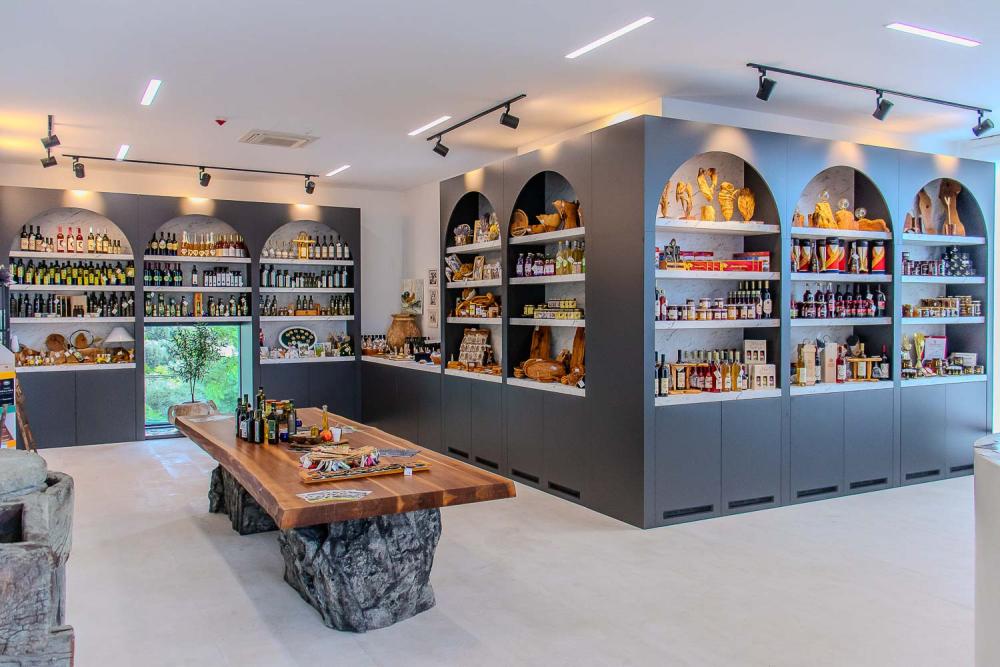
The heat of the “House of Olives” is the sales-exhibition salon with more than 500 agricultural, food products and handcrafted souvenirs, which tell the stories of industrious Montenegrin peasants and craftsmen, from the South to the North of our pearl of the Mediterranean. The reactions of olive growers, other farmers, but also all the tourists and visitors are very positive. We offer numerous olive oils, edible olives, souvenirs and utility items made of olive wood, homemade syrups, juices and jams, red wines, white wines and rosés, brandies and other spirits, cheeses and dairy products, honey and bee products, marine and lake fish, cosmetic and pharmaceutic products and handicrafts, as well as confectionery. Tourists’ preferences do vary, but they most often come with the intention of purchasing superior extra-virgin olive oil and olive wood souvenirs, which will always remind them of their tour of Bar, the town the other name of which is Olive.
CM: Can you reveal some interesting story about the people whose products you exhibit or about some particularly important item one can purchase there?
Among more than 500 products it is difficult and ungrateful to choose just one, since every one of them comes with a story. Nevertheless, I will present to you the work of one Bar family from Šušanj neighbourhood, whose products occupy prestigious first place when it comes to the number of sold items in the House of Olives. It is the OLAV OLIVE WOOD MONTENEGRO company, i.e. Malović family, who processes the wood originating from the regular annual regenerative clipping of olive trees. This family gives olives eternal life. The products of the OLAV OLIVE WOOD MNE brand do leave indifferent any visitor who takes with him/her the most beautiful memory in the form of a unique wooden object or souvenir of golden honey colour which is reminiscing of the sunlit Mediterranean.
CM: In the House of Olives different events are organized, from literary evenings, through workshops, to professional seminars. Which event would you single out as the most interesting?
In the House of Olives, for one year of its operation, numerous events were organized - competitions, hackathons, literary evenings, promotions, music events, exhibitions, fashion shows, as well as thematic agricultural events. I am taking the opportunity to thank all those who have found the inspiration in the House of Olives for the realization and presentation of their ideas and work, and I would single out the event we launched at the beginning of 2025, which is definitely going to become traditional. In fact, the National competition for the quality of olive oils and olive products - MNEOOC 2025 was held on the occasion of the 2250th birthday of the Old olive tree and of the anniversary of the establishment of the Agricultural Society. The results achieved by the olive growers at the competition prove world-class quality of our products. The response of the olive growers to the national competition was exceptional and the olive oils which took part in the competition come from Montenegrin cities/towns and municipalities where olives are successfully grown.
CM: What is tourists’ experience when they enter the House of Olives?

If I were to describe their experience in one word, I would say they are surprised. Primarily with the scale of the edifice itself, then also with the offer, which is certainly one of the richest in the area of Montenegrin agriculture and agritourism. We have not seen a single dissatisfied tourist in the House of Olives, but what is even more important to me, we have not met a single dissatisfied local visitor either. Out task and the source of income is providing tourist experience, but also raising awareness of our citizens of the significance and importance of olive growing.
CM: What are their reactions when they hear that the Old olive tree in Bar is one of the oldest in Europe?
There are numerous legends which the Old olive tree at Mirovica features in and which would always in the end bring happiness, peace and success. The custom which is still observed is that everyone who visits the Old olive tree at Mirovica should go around it three times, one circle is for health, the second one for happiness and the third one for love. Tourists never skip this custom! This legend originated from another legend which tells about the curse of a wealthy Bar family disappearing when the wedding party of the fifth, youngest son, started dancing around the tree thus bringing happiness back to their home with the birth of twelve children during the subsequent twelve years. The vow for the preservation of the Old olive tree was being transmitted from generation to generation, and older citizens are familiar with the strictest prohibition of cutting its branches or leaves.
CM: What kind of a story do you like your guests from all over the world to take home with them from the visit to the House of Olives?

The phrase Montenegrins particularly like to use when bragging to the foreigners is that in one day you can enjoy the snow-covered mountain tops, as well as the unique sea or lake shores. It is exactly the valorisation of the House of Olives that contributes to the achievement of the year-round, so-called tourist “365” offer. With the development of rural tourism, Montenegro reduces the gap which exists between the unjustly neglected northern region and the south which is under constantly growing urbanisation threat. Thanks to the long-awaited beginning of the operati0on of the House of Olives in the Old Town of Bar, oleo tourism is a new niche of the tourist offer of Bar representing one of the fastest growing in the Mediterranean region. Within the broadest meaning of the notion, it covers everything which is done in the field of olive growing and production of olive oil, which can attract attention of modern tourists, from gastronomy to accommodation and medical treatments, including even deeper understanding of the specific culture-life philosophy of the world of olive growers.